Buying a new phone used to be a festival in my life. My “first“ phone was the mighty original Samsung Galaxy Note. I did use a phone before that, but that was just my dad’s spare phone, and not very exciting or smart.
Getting the Note meant going straight from a feature phone to the flagship at that time. It was a huge change. For the first time, I could take a picture of text in books and actually be able to read it later. It is hard to believe today that that wasn’t a given just 15 years ago.
It was also an Android Smartphone. Both words were not the default at the time, so it felt special. The functionality could be extended by downloading “apps” which were like software but somehow easier to install and seemed more fun.
Coming from a desktop computing mindset, I quickly got into modding the phone through means of aftermarket-ROMs (operating systems provided by third party developer and not the phone manufacturer). These aftermarket-ROMs often promised various improvements over the stock operating system that the phone came with, including performance and battery life improvements, but also mimicking other phones’ UI and features (it would usually be the Google Pixel’s features that got copied, sometimes Samsung’s).
It made a lot of sense. A phone was, after all, a general-purpose computing device, right?
Well, it probably wasn’t then, but the trend was already towards thinking of smartphone ecosystems as these walled gardens focussed on manufacturer-control and providing features that just work. Most consumers didn’t want a moddable smartphone. They just wanted one that worked well. This meant that the wide choice array of smartphones and smartphone manufacturers, each coming with their own set of philosophies and opinions, started copying each other in a race to capture the biggest market share.
An example of this is how Apple made fun of Samsung for making phones that barely fit people’s hands, but promptly copied them in the subsequent generations. Meanwhile, Samsung flaunted that their phones still retained the headphone jack and came with chargers until they didn’t.
I’m hardly trying to make a point here. We all know these things to varying degrees of clarity. Technology companies aren’t charities. They certainly aren’t whatever enthusiast-friendly cool-guy personae they sometimes try to pull off. They’re trying to steal the market share of the next company, convincing you that the only thing in life you lack this year is their newly released flagship phone.
Anyway, I got myself an iPhone 17 Pro.
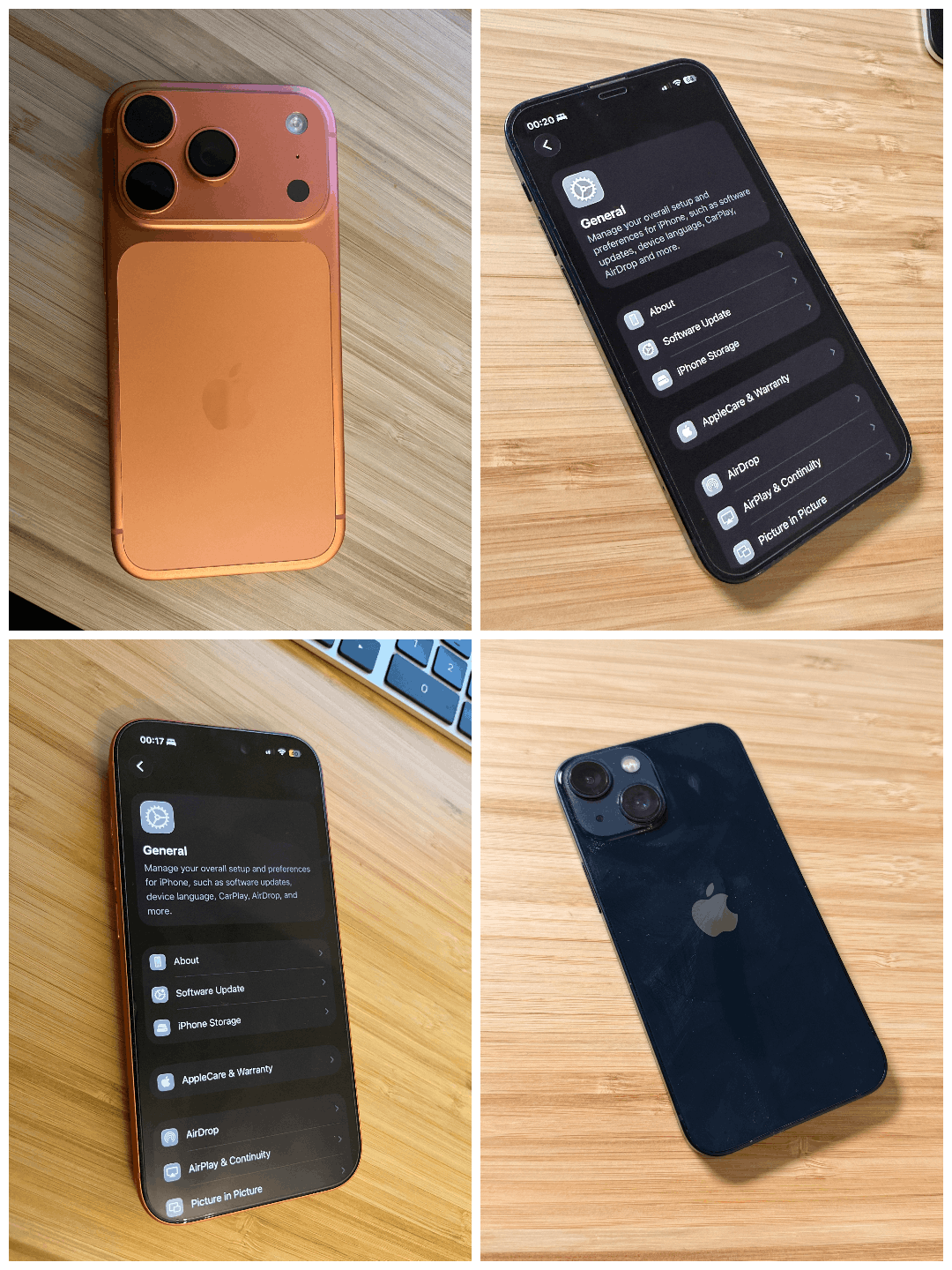
Nymisha was in the States, and I made use of this opportunity to secure for myself the latest Apple’s flagship phone at a slightly discounted price.
My older phone, the iPhone 13 Mini, was over four years old, and while it didn’t fall behind, it definitely showed age in the way its battery held charge. Knowing how much I rely on a smartphone in my pocket (not proud, but no longer resisting either), I decided to get a phone that will last another four years, has good cameras and battery life even in its fourth year of service, and is relatively secure.
I researched for an entire month and educated myself on the state of the smartphone industry after a nearly 8-year hiatus from smartphone tech. To be honest, not much had changed since the last time I did such extensive research. Pictures were sharper, but not all that much. My Pocofone F1 with its Gcam mod took excellent photos, and the iPhone 13 mini wasn’t a huge step up over it (and was even considered a flagship when I bought it in 2021). A few phones came across as marginally more exciting, camera-wise, like the Vivo X300 Pro, but they had limited software support or weren’t available in the EU.
After my month-long research, I decided to go with the flagship Apple. I was almost certain I’d not get another iPhone after the 13 Mini (to the point where I’d explicitly say that to my fellow nerd friends, with whom speaking about smartphone models isn’t uncommon). But the high walls of Apple’s ecosystem and already owning an Apple MacBook for work, among other things, meant that life could be a lot easier with an iPhone and full of Apple and other manufacturer-created friction without one.
That, along with the fact that iPhones are perfectly decent feature-complete smartphones if you can afford them, made the choice clear.
The motivation to write this article came when I was trying to compare the camera quality between my two iPhones: the 13 Mini and the 17 Pro. Given the age of my old phone and that it wasn’t a “pro” even when I first bought made me think it wouldn’t even be a competition.
My old phone didn’t take bad pictures. Far from it. This belief that the new one would be a game-changer was mostly based on marketing hype. Something that I did expect to make a real difference was the addition of the telephoto lens to the phone camera arsenal. Over the next few weeks of owning both the iPhone 17 Pro and the iPhone 13 Mini, I decided to start documenting what’s really different between the two phones and what’s the same or practically similar.
This article is written with the motivation to help understand the differences a phone upgrade makes, specifically for people who don’t care about the latest generation of flagship smartphones every year.
Differences
Getting a new phone means looking at the differences on paper and in the real world. On paper, the differences are always blown out of proportion due to marketing hype and the average consumer’s lack of understanding of the technical intricacies. I want to document them from my perspective, especially if there’s a before-and-after difference in that perception, something I thought would be useful for future readers, including myself.
Prices
My old phone was cheaper than my new phone when I bought them. It makes relative sense. The difference is around ~250 euros, which, honestly, made me feel like I overpaid for the 13 Mini when I first got it. The iPhone 17 Pro is without a doubt a lot more phone than the 13 Mini, all things aside.
In that sense, paying a couple of hundred extra for the phone that’s just more phone makes sense. Whether the prices themselves make sense in an absolute sense is a question for a different blog article.
Cameras (especially the telephoto lens)
I already knew this would be exciting for me. When I bought my Sony RX100 MK5A point-and-shoot camera, I found myself exclusively shooting at its highest focal length, 70mm or beyond (using Sony’s Clear Zoom). I always thought the 24-26mm wide lenses that phone cameras came with were a bit too wide.
I wasn’t wrong. With the 17 Pro, I found myself often defaulting to the 100mm telephoto camera. The flatter profile of the pictures from this camera and the ability to reach farther without being intrusive made a huge difference to my photo-taking experience.
Battery life
The single biggest reason for friction with my old phone was the battery life. My iPhone 13 Mini was left with a battery health of 76%. If I start my day with a full charge, I’d need to recharge by lunch. The battery life was never good, even when I first bought the phone, but it was outright bad in the latter half of the phone’s life. To avoid paying Apple 100 euros for a battery replacement (or handing my phone to a local service shop), I bought a beefy power bank and carried it with me for any outing longer than half a day. It solved the problem by replacing it with a smaller problem. I guess that’s how human progress happens, and it worked for me for a year and a half.
It is always a tradeoff, of course. There’s hardly another phone I’d rather use with one hand while riding a bike than my Mini. Not recommended, but if I had to, the mini with its tiny battery life, it is.
High refresh rate display
A much-awaited smartphone feature in my life was the high refresh rate display. It surrounded a lot of fanfare, typically from tech YouTubers who made it sound like that’s a major difference maker in one’s phone experience.
For me, there was a difference, although not as big as YouTube makes it seem. Scrolling through apps and menus is smoother and feels more fluid. The rest of the phone feels the same, and I’d not consider this one thing worth the upgrade, although it is noticeable and nice to have.
Large screen
Something I told myself was that if I had a phone with a bigger screen, I’d be more productive on the go. That has been more or less true so far. A bigger screen is simply more pleasant to type on, read, and check messages on. It is also better to scroll through social media or watch content on it, so the higher-productivity part may vary depending on how it is used. Either way, I ended up clocking more screen time than before.
Similarities
I think the topic of similarities is just as important as the previous one. Tech reviewers do a good job at highlighting what’s changed. Overemphasizing what’s changed creates a skewed perception that everything’s changing all the time. That’s hardly the truth. No one would watch an MKBHD video if he talks about the similarities between a previous and current-gen iPhone for 95% of the time, but that’s exactly what a fair representation of the rate of tech change in smartphones will feel like.
That’s part of the reason phone company marketing teams have to resort to talking about technical details that are so far removed from lived experience that it constantly flirts with the boundary of meaninglessness (think megapixels or CPU core count).
Working good enough phone
A similarity between my four-year-old phone (and even the eight-year-old Pocofone F1) was that they were both perfectly functional, good smartphones. I could use my messenger, bank, social media, email, and pretty much any apps on both of these phones as I do on my latest iPhone.
Buying a new phone so that you can use an app that your four-year-old phone doesn’t support never happened to me. That also meant that there wasn’t anything particularly interesting, software-wise, that I was looking forward to when I got this new phone.
Cameras (especially the main lens)
I remember taking both my phones out and taking pictures, both daylight and nighttime, to compare the cameras and especially the main camera (also called the wide-angle camera, not the ultrawide or periscope zoom camera) performance between the two phones.
If I’m being completely honest, the pictures looked something between outright better on the iPhone 17 Pro (low light, zoomed in details), to marginally better or near identical (bright daylight, no crop), depending on the lighting situation. There was surely a difference, but not as much as the yearly tech keynotes would make you believe.
For most pictures, you’d really have to go looking for differences (also called pixel peeping). On a 100% crop, that is, without zooming into the pictures, more often than not, the pictures look the same.
Edit – 11th January 2026: I went out to take some sample pictures from both phones. While it is isn’t a scientific test by any means, it should give you a general idea of how the main camera pictures compare between four generations apart pro versus non-pro iPhone models.

Performance
Performance, as measured through real-world usage of the phone, is identical. Trust me, if you use your phone for messaging, internet and social media browsing, cameras, music, and light productivity, you’d be hard-pressed to find a difference between the two devices. It is hard to believe, looking at the numbers on paper (4 vs 12 gigabytes of RAM and A13 Bionic vs 17 Pro benchmark numbers), but that’s what I’ve experienced. The iPhone 13 Mini mostly ran without performance hiccups, so there’s little that can be fixed over what’s already not broken, so it would be wrong to expect otherwise.
Now granted, many performance gains are about sustained performance and not burst, but given that I don’t game heavily on my smartphone, edit and export 4k videos, or do any of the “Pro” stuff, it is hardly a surprise that my old phone was adequately performant.
In closing
I don’t want to say it too many times, but smartphones aren’t nearly as interesting as they used to be. That’s not a bad thing, though. Air travel is not interesting either, in the sense that it just works. For air travel, I’m happy with it not being interesting. For smartphones, a part of me wishes that companies were more ambitious with their designs and experimentations. Then another part of me reminds myself how little I relied on my smartphone 10 years ago and mostly used it as a nice-to-have luxury accessory, and how it is now — a critical part of my daily life.
If my research proved anything, it is that there are companies still pushing the boundaries and innovating. They’re just not mainstream or guaranteed to last another few years to provide updates to their products. It is a question of how inconvenienced I’m willing to be to adopt a life with a phone that has an ambitious design. In my recent phone purchase, I wasn’t much. Hopefully, I can revisit this stance in the future or just have spare fun smartphones to play around with.
Thank you for reading!